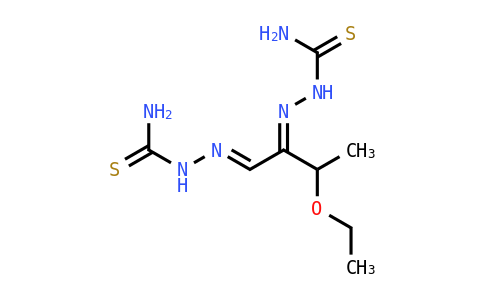
Gloxazone
Gloxazone is an effective but toxic anaplasmacide.
For research use only. We do not sell to patients.
Chemical Information
| Name | Gloxazone |
|---|---|
| Iupac Chemical Name | Butyraldehyde, 3-ethoxy-2-oxo-, bis(thiosemicarbazone) |
| Synonyms | 356C61; BW 356C61; BW356C61; BW-356C61; Contrapar; Gloxazon; Gloxazone; NSC 82116; NSC-82116; NSC82116; U 7726; U-7726; U7726; WR 9838; WR9838; WR-9838; |
| Molecular Formula | C8H16N6OS2 |
| Molecular Weight | 276.38 |
| Smile | CC(OCC)C(/C=N/NC(N)=S)=N\NC(N)=S |
| InChiKey | ARIFZLJIERKKEL-SNNHKCHZSA-N |
| InChi | InChI=1S/C8H16N6OS2/c1-3-15-5(2)6(12-14-8(10)17)4-11-13-7(9)16/h4-5H,3H2,1-2H3,(H3,9,13,16)(H3,10,14,17)/b11-4+,12-6- |
| CAS Number | 2507-91-7 |
| Related CAS |
Ordering Information
| Packaging | Price | Availability | Purity | Shipping Time |
|---|---|---|---|---|
| Bulk | Enquiry | Enquiry | Enquiry |
| Formulation | Solid powder |
|---|---|
| Purity | 98% Min. |
| Storage | Dry, dark and at 0 - 4 C for short term (days to weeks) or -20 C for long term (months to years). |
| Solubility | Soluble in DMSO |
| Handling | |
| Shipping Condition | Shipped under ambient temperature as non-hazardous chemical. This product is stable enough for a few weeks during ordinary shipping and time spent in Customs. |
| HS Code |
| Targets | |
|---|---|
| Mechanism | |
| Cell study | |
| Animal study | |
| Clinical study |
1: McHardy N, Berger J, Taylor RJ, Farebrother D, James JA. Comparison of gloxazone, an effective but toxic anaplasmacide, with imidocarb dihydrochloride. Res Vet Sci. 1980 Sep;29(2):198-202. PubMed PMID: 6451008.
2: Du Plessis JL. The influence of dithiosemicarbazone on the immunity of sheep to heartwater. Onderstepoort J Vet Res. 1981 Sep;48(3):175-6. PubMed PMID: 7335333.
3: Du Plessis JL, Berche P, Van Gas L. T cell-mediated immunity to Cowdria ruminantium in mice: the protective role of Lyt-2+ T cells. Onderstepoort J Vet Res. 1991 Sep;58(3):171-9. PubMed PMID: 1923379.
4: Wassink LA, Franssen FF, Uilenberg G, Perié NM. Observations on mouse-infective stocks of Cowdria ruminantium: attempts to demonstrate persistence of the organism in mice immune to the Kwanyanga stock. Res Vet Sci. 1987 Jan;42(1):65-7. PubMed PMID: 2950579.
Chemical Structure